
Arcadia Mayor Charged as Illegal Agent of the Chinese Government
05/13/26
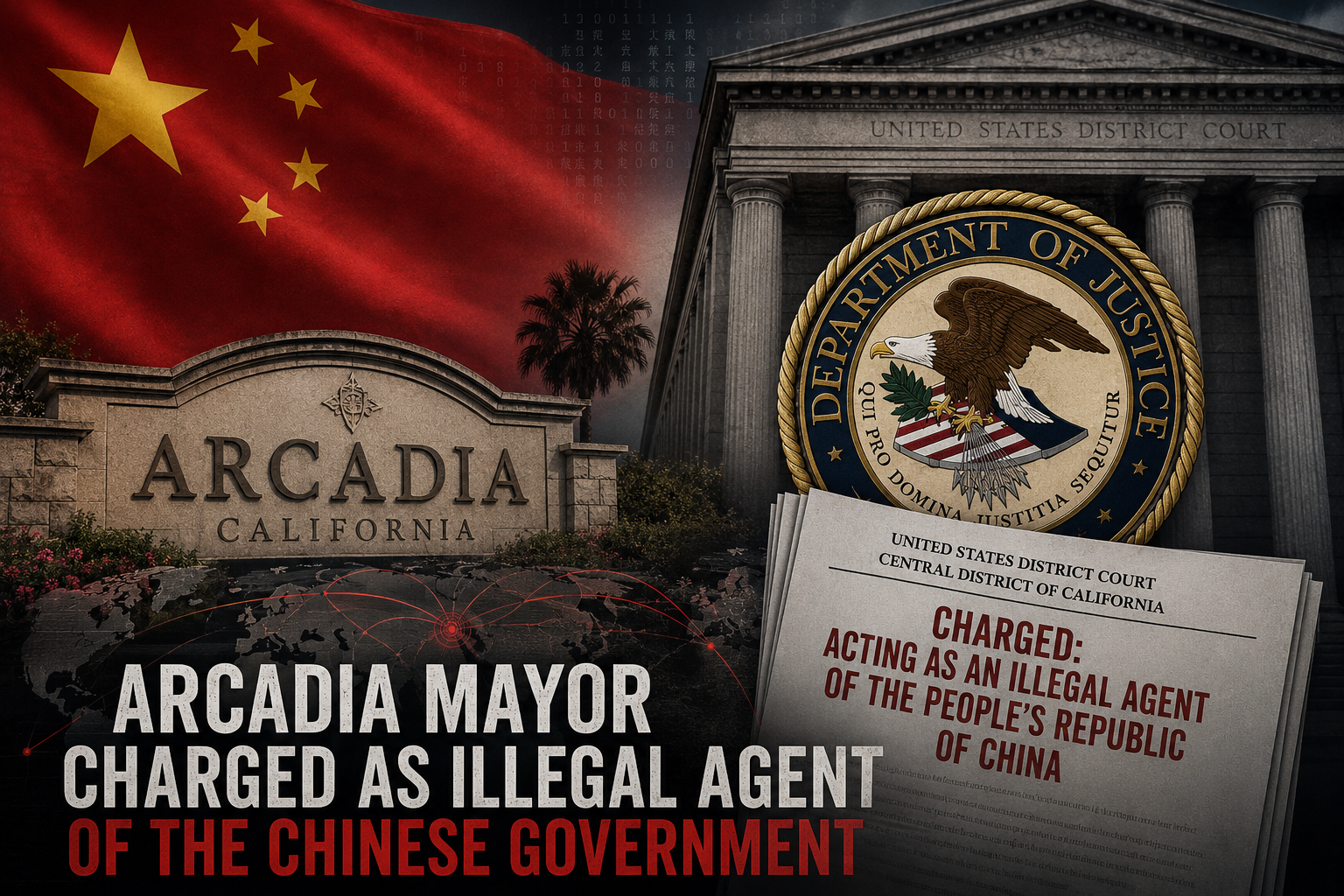
A political scandal unfolding in Southern California has once again drawn national attention to the growing concerns surrounding Chinese Communist Party influence operations in the United States. Federal prosecutors announced this week that Arcadia Mayor Eileen Wang has been charged with acting as an illegal agent of the People’s Republic of China (PRC), accusing her of secretly advancing Beijing’s interests while later serving in public office.
According to the U.S. Department of Justice, Wang allegedly worked under the direction of Chinese government officials between 2020 and 2022 alongside Yaoning “Mike” Sun, a Chinese national who previously pleaded guilty in a related foreign-agent case and is currently serving a four-year federal prison sentence. Prosecutors say the pair coordinated efforts to spread pro-Beijing propaganda inside the United States through a Chinese-language media platform while concealing their relationship with PRC officials.
Federal authorities allege that Wang failed to register with the U.S. government while acting on behalf of a foreign state, a violation that carries a potential sentence of up to ten years in prison. In a plea agreement filed in federal court, Wang reportedly admitted that she did not disclose her activities or notify the Attorney General as required by law.
The case has sparked widespread concern because Wang later became an elected official in Arcadia, a city in Los Angeles County with a large Chinese-American population. She was elected to the Arcadia City Council in 2022 and became mayor earlier this year through the city’s rotating mayoral system. Following the federal announcement, Wang resigned from office.
The Justice Department described the allegations as part of a broader pattern of foreign influence operations conducted by the Chinese government inside democratic societies. Assistant Attorney General John Eisenberg stated that public officials in the United States “should act only for the people of the United States that they represent,” warning that undisclosed ties to foreign governments undermine public trust and democratic institutions.
While the case has generated headlines because of its connection to a sitting mayor, it also reflects broader concerns about transnational repression and political influence campaigns linked to Beijing. Over the past several years, U.S. authorities have increasingly investigated allegations involving Chinese state influence operations targeting diaspora communities, local governments, media organizations, and activists across the country.
For many Uyghurs and other communities affected by Chinese government repression, these developments reinforce long-standing concerns about how Beijing seeks to shape narratives and suppress criticism far beyond China’s borders. Uyghur activists, journalists, and diaspora organizations have repeatedly warned that the Chinese government attempts to influence foreign institutions while intimidating communities abroad through propaganda, surveillance, and political pressure.
The Arcadia case also raises difficult questions about transparency, foreign influence, and the vulnerability of democratic systems to covert political operations. Although prosecutors stated there is no evidence Wang misused city resources while in office, the allegations have intensified scrutiny over how foreign governments cultivate political relationships at the local level in the United States.
As federal investigators continue examining Chinese influence activities across the country, the case against Wang may become one of the most high-profile examples yet of alleged PRC political infiltration at the municipal level.