
Rethinking The Label “Ancient Chinese Saddle” in the Turpan Discovery
By Former Senior Journalist Jilil Kashgary
05/08/26
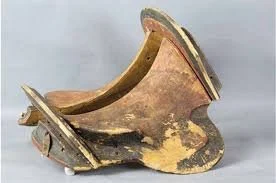
A recent article by Braden Phillips in National Geographic brought global attention to an extraordinary archaeological discovery: a remarkably preserved horse saddle unearthed from a woman’s grave in the Turpan Basin in today’s Xinjiang Uyghur Autonomous Region.
Dating to roughly 2,700–2,400 years ago, the saddle is considered one of the earliest known examples of a functional riding saddle. While the discovery itself has been widely celebrated, the way it has been framed — specifically as an “ancient Chinese saddle” — has sparked debate among historians and scholars.
Researchers such as Patrick Wertmann have noted that horseback riding was likely introduced into northwestern regions of present-day China from the Pazyryk culture area of the Northern Altai. Although the Yanghai saddle may predate those discovered in the Pazyryk region, the broader technological and cultural context appears deeply connected to the wider Eurasian steppe world.
The Discovery in the Subexi/Yanghai Cemetery
The saddle was excavated from burial sites associated with the Subexi/Yanghai culture in the Turpan Basin. Dated between approximately 700 and 400 BCE, the artifact challenges assumptions about who used riding equipment and how early horseback mobility developed.
These graves belonged to Iron Age pastoralist communities living across the arid landscapes of Inner Asia. Archaeologists believe the saddle was buried with a woman who was likely a rider herself, highlighting the important role of women in steppe and oasis societies.
Constructed from stitched animal hides stuffed with straw, deer hair, and camel hair, the saddle reflects an early effort to improve rider stability while reducing pressure on a horse’s spine. It consisted of two wing-shaped leather cushions sewn together along the outer edges and separated by an unstuffed central section, or gullet, designed to protect the horse’s back.
Technologically, the object represents a major step in the evolution of mounted travel, communication, and warfare.
Why the Label “Ancient Chinese” Is Controversial
The debate surrounding the discovery is not about the significance of the artifact itself, but about the terminology used to describe it.
Referring to the object as an “ancient Chinese saddle” raises historical, geographical, and political questions. Around 700 BCE, the modern nation-state of China did not exist. The region now known as China consisted of multiple kingdoms, tribal confederations, and cultural spheres, many of which had limited or no political connection to the distant oasis communities of the Turpan Basin.
The Qin and Han dynasties — often associated with the foundations of imperial China — would not extend influence into large parts of the northwest until centuries later. As a result, applying a modern national identity to communities living in the Turpan region nearly three millennia ago risks projecting contemporary political concepts onto a far more complex historical landscape.
Turpan and Early Eurasian Networks
Historical and archaeological evidence suggests that the Turpan Basin was part of a broader network of steppe and oasis cultures stretching across Inner Asia.
The people who inhabited the region were experienced horse riders whose technologies and cultural practices were connected to wider Eurasian exchange systems rather than to a single political center. Their material culture — including horse equipment, textiles, and burial customs — reflects interactions with neighboring pastoralist societies across the steppe.
This does not diminish the importance of the find within the history of China or East Asia. Rather, it situates the discovery within a larger transregional story of mobility, exchange, and innovation.
Cultural Labels and Historical Precision
The issue, therefore, is one of historical precision.
Describing the artifact simply as “ancient Chinese” can unintentionally flatten the diversity of cultures that existed across Inner Asia during the Iron Age. More precise alternatives might include:
An early saddle from the Turpan Basin
A saddle from Iron Age steppe-oasis cultures
One of the world’s earliest saddles from Inner Asia
Such descriptions acknowledge the artifact’s geographic location without assigning a modern national identity to people who lived long before those identities emerged.
Why Terminology Matters
Archaeology is not only about excavating objects; it is also about shaping narratives about the past.
The language used to describe discoveries influences how global audiences understand history. When modern national labels are applied too broadly to ancient cultures, the complexity and diversity of historical societies can become obscured.
The Turpan saddle is historically significant because it demonstrates:
The early role of women in horseback riding
Technological innovation among steppe and oasis cultures
The interconnected nature of Eurasian societies long before modern borders existed
These insights stand on their own and do not require modern national framing to be meaningful.
A Discovery That Belongs to Global History
The saddle discovered in the Turpan Basin is best understood as part of the shared heritage of early horse-riding cultures across Eurasia.
Rather than belonging exclusively to any single modern nation, it represents a milestone in human adaptation, mobility, and technological innovation. The development of more comfortable riding equipment allowed people to travel farther, maintain wider networks of exchange, and transform communication across vast distances.
As archaeologist William Taylor and other researchers have argued in studies of early riding technologies, advances in saddle design reflected increasing concern for both rider safety and the health of horses.
In that sense, the most compelling aspect of the Turpan discovery is not whether the saddle should be labeled “Chinese,” but how it reflects the ingenuity of ancient peoples whose innovations helped reshape Eurasian history.
Link to the National Geographic Article: https://www.nationalgeographic.com/premium/article/worlds-oldest-horse-saddle